

This flag can withstand extreme environments such as medium, high, and low temperature fluctuations, high vacuum conditions, and strong ultraviolet radiation. When it became the first national flag to fly on the far side of the moon, it attracted the attention of people around the world.
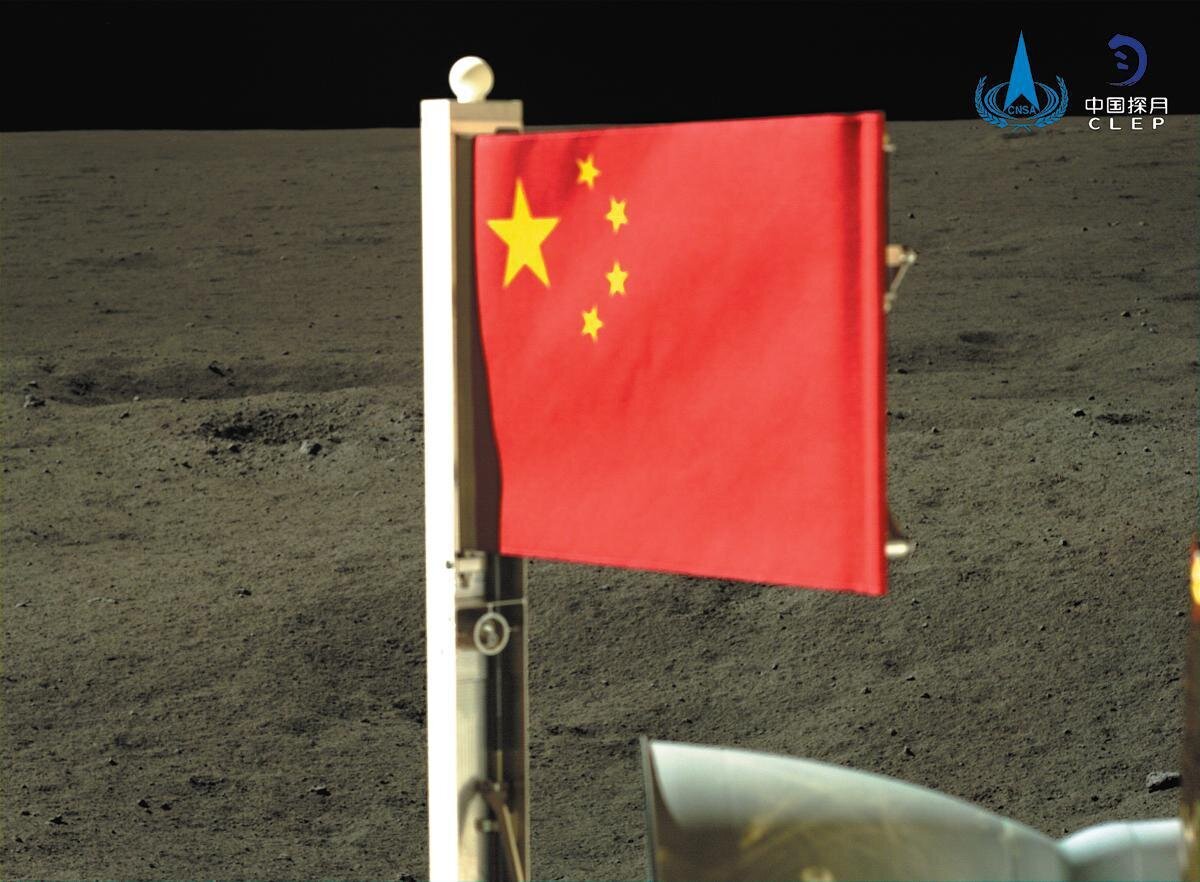
Xu Weilin, an academician of the CAE Member, said that after overcoming the main obstacles in the past four years, his team has successfully developed a high-quality "lithographic" fabric flag, including the difficulty in weaving fibers and ensuring that the color will not fade.
According to Xu, the president of Wuhan Textile University in Hubei Province, basalt fiber has excellent thermal insulation and radiation resistance, so it can withstand harsh lunar environments. Basalt fiber is an inorganic fiber characterized by smooth surface, brittleness, and fragility, which makes it difficult to spin and weave.

The flag deployed by Chang'e-6 on the moon is the same size as the flag placed on the near side of the moon during the Chang'e-5 mission -30 centimeters by 20 centimeters, approximately the size of an A4 paper.
Principal Xu said that the density of basalt fibers used in the Chang'e-6 flag is almost twice that of the Chang'e-5 flag, which gives us reason to believe that the basalt fiber flag is heavier.
However, Xu's team has developed ultrafine basalt fibers with a diameter of about one-third of a human hair, so the weight of the Chang'e-6 flag is only 11.3 grams, which is 0.5 grams lighter than the Chang'e-5 flag.